


Steppe
Collection
Family of generative latent upscalers: small generative models trained only for upscaling, which run directly on VAE latents • 2 items • Updated
🧩 ComfyUI nodes: ComfyUI-Steppe
Available in ComfyUI-Manager: search for "Steppe" and install (or
comfy node install steppe). FLUX.2 support needs version 1.1.0 or newer. The nodes download these models on first use.
Steppe is a family of generative latent upscalers: small generative models trained only for upscaling, which run directly on VAE latents. The upscaled latent is decoded straight by the VAE: no second sampling pass of the base model, no hires fix, no prompt.
These models upscale latents of the FLUX.2 VAE, the latent space shared by FLUX.2 [dev], FLUX.2 [klein] and MOSS-Image.
Images only: unlike the Wan 2.1 models, there is no temporal (frame rate) upscaling.
Install ComfyUI-Steppe: search for "Steppe" in ComfyUI-Manager,
or run comfy node install steppe. The models download automatically on first use.
KSampler → Steppe Upscale Latent → VAE Decode
Select a steppe_flux_2_* model in Load Steppe Upscaler (the same loader lists the Wan 2.1 models). Leave
steps / shift at 0 for the recommended base model sampler (30 steps, shift 2).
To install the models manually, put the files into ComfyUI/models/latent_upscale_models.


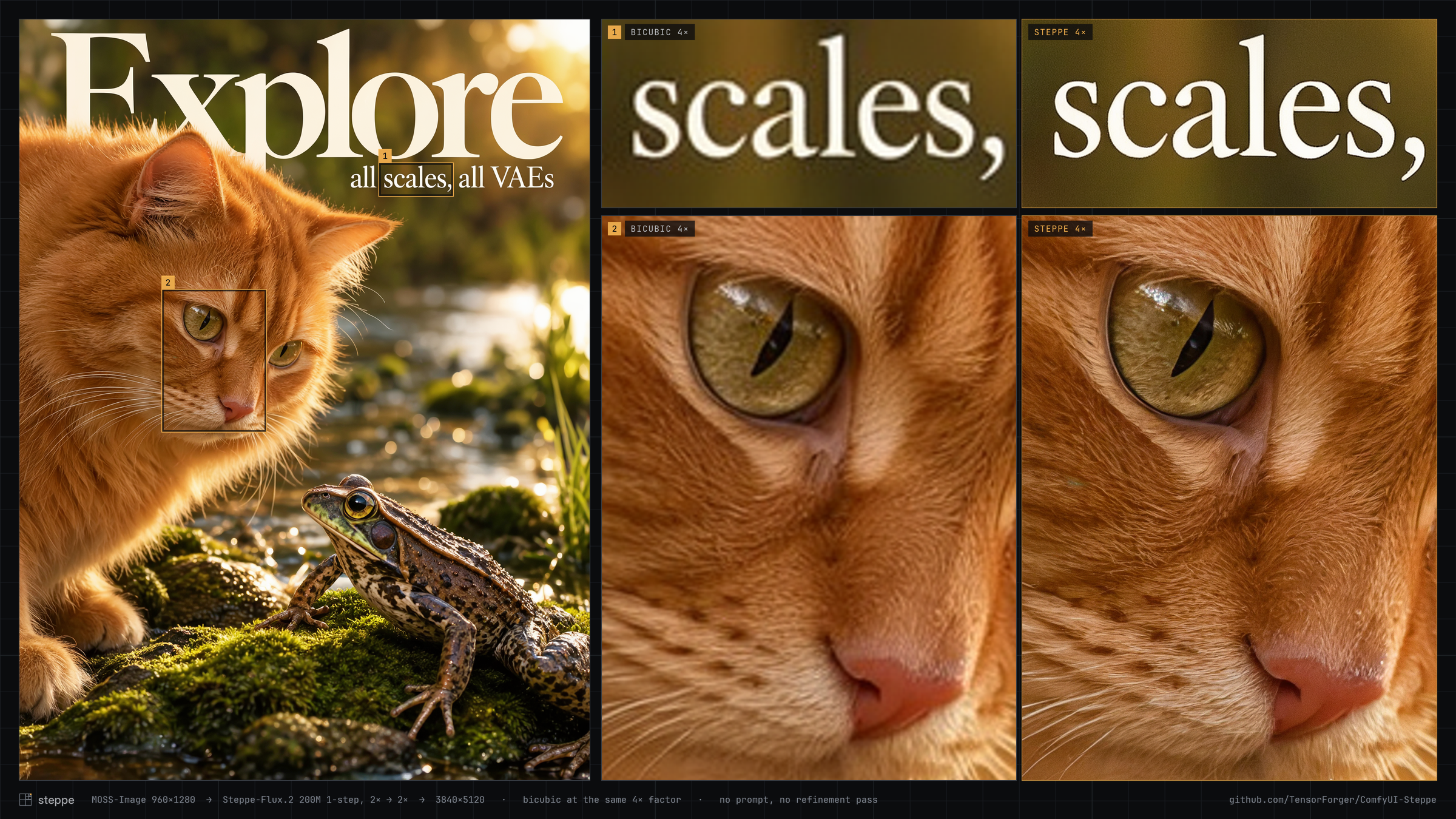
All examples: MOSS-Image at 960x1280, Steppe-Flux.2 200M 1-step, chained 2x → 2x to 3840x5120, no prompt and no refinement pass. Bicubic tiles are upscaled by the same 4x factor from the same input. Click an image for the full resolution card.
| file | steps | parameters | use |
|---|---|---|---|
steppe_flux_2_200M_1step.safetensors |
1 | 192M | default, 90% of use cases: the quality of the base model in one step |
steppe_flux_2_200M_base.safetensors |
1-200 (30) | 192M | most control and research: steps, CFG on hff; same quality as the 1-step model in general use |
steppe_flux_2_20M_1step.safetensors |
1 | 20.2M | lite: 6x faster model pass, very large outputs, real time use; with a tiny decoder (TAEF2) the whole pipeline is ~19 ms |
All files are bfloat16 safetensors with the model configuration in the metadata. config.json is the catalog of this
repository (versions, recommended settings).
| model | VAE | status |
|---|---|---|
| FLUX.2 [dev] | FLUX.2 VAE | native |
| FLUX.2 [klein] 4B / 9B (distilled and base) | FLUX.2 VAE | native |
| MOSS-Image (SFT and base) | FLUX.2 VAE (small decoder) | native |
| FLUX.2 small decoder, TAEF2 (madebyollin/taef2) | FLUX.2 VAE decoders | works, TAEF2 benchmarked |
| FLUX.1, Wan, Qwen-Image, SD3, SDXL, … | other VAEs | not supported here (Wan 2.1 VAE: Steppe-Wan2.1) |
Tested in ComfyUI with FLUX.2 [klein] 4B (flux2-vae) and MOSS-Image (flux2-vae_small), single 2x and chained
2x → 2x. Both workflows are in
ComfyUI-Steppe/example_workflows.
0...1, default 0.9): target amount of fine detail and sharpness. Off (-1) lets the model choose.
The values are absolute: an Immerkaer noise estimate, quantile-normalized on ReLAION photos. hff acts much more
strongly on these models than on the Wan 2.1 ones.
1000 photos (Axis-V1), 512 → 1024. Every solution gets only the FLUX.2 latent (no prompt, no hff). Patch FID on native 256 px tiles (lower is better); latency at batch 1, VAE decode included, RTX 5090, eager bfloat16.
| solution | patch FID | FID | latency | peak VRAM |
|---|---|---|---|---|
| Steppe 200M base, 30 steps | 1.72 | 1.95 | 1671 ms | 3.0 GB |
| Steppe 200M 1-step | 1.75 | 2.02 | 172 ms | 3.0 GB |
| Steppe 20M 1-step | 2.20 | 2.63 | 131 ms | 2.6 GB |
| Steppe 200M 1-step + TAEF2 decoder | 3.22 | 4.55 | 60 ms | 1.0 GB |
| Steppe 20M 1-step + TAEF2 decoder | 3.81 | 5.17 | 19 ms | 0.7 GB |
| FlowUpscaler (our previous FLUX.2 model) | 4.28 | 4.50 | 128 ms | 2.7 GB |
| SPAN 2x after decode | 6.18 | 3.67 | 30 ms | 0.8 GB |
| SesquiLSR FLUX.2 (latent, made for hires fix) | 7.71 | 7.26 | 124 ms | 2.6 GB |
| bicubic after decode | 8.12 | 1.77 | 25 ms | 0.8 GB |
| Real-ESRGAN x2 after decode | 9.03 | 7.99 | 53 ms | 0.8 GB |
The VAE reconstruction limit on this set is patch FID 0.71. Steppe stays close to the input: roundtrip color error ΔE00 1.82 (bicubic 1.74). A FLUX.2 [klein] 9B LoRA upscaler (Hildegard, 4 steps, ~7 s per image) was compared on 30 images: it adds plausible detail but moves away from the input (ΔE00 3.8 at best vs 2.2 for Steppe on the same images).
Benchmark images: Axis-V1 by refine-axis (CC BY 4.0), cropped.
pip install "steppe[standalone] @ git+https://github.com/TensorForger/ComfyUI-Steppe"
from steppe import UpscaleSettings, load_upscaler

upscaler = load_upscaler("steppe_flux_2_200M_1step.safetensors")
upscaler.model.to("cuda")

# FLUX.2 latents as ComfyUI and the diffusers FLUX.2 pipelines use them: 2x2 packed and batch norm normalized,
# [B, 128, H / 16, W / 16]. From a bare AutoencoderKLFlux2: patchify the 32 channel latent 2x2 (channel order
# C, 2, 2) and normalize it with vae.bn.running_mean / sqrt(vae.bn.running_var + 1e-4).
upscaled = upscaler.upscale(
    latents, UpscaleSettings(hff=0.9, guidance=1.0)
)  # [B, 128, H / 8, W / 8]
A window transformer runs on the full resolution latent grid (32 channels, 1/8 of the image). It uses DiT style adaLN-zero blocks, shifted 8x8 window attention and QK-norm. A learned source encoder upsamples the input latent. The model generates the normalized residual over the aligned low resolution latent with rectified flow, conditioned on the noise level and the hff.
The architecture and recipe come from agent-driven autoresearch on FLUX.2 and Wan 2.1 latents (rounds of parallel 30 min training runs, judged by patch FID).
MIT. Steppe works on latents of the FLUX.2 VAE (Apache-2.0, Black Forest Labs), see NOTICE. This repository
does not contain VAE or FLUX.2 model weights.
The ancestor of Steppe is comfyui-flow-upscaler (FLUX.2).
@misc{steppe2026,
  author = {TensorForger},
  title = {Steppe: Generative Latent Upscalers},
  year = {2026},
  url = {https://huggingface.co/TensorForger/Steppe-Flux.2}
}
Base model
OpenMOSS-Team/MOSS-Image-Base