

FoundYou: A Unified Model for Personalized Segmentation and Retrieval
Paper • 2608.29917 • Published
Paper (arXiv) · Code · Project page · Demo
ECCV 2026 · Gabriele Trivigno*, Marcos Alfaro*, Claudia Cuttano*, Gabriele Berton, Luis Payá, Carlo Masone (* equal contribution)
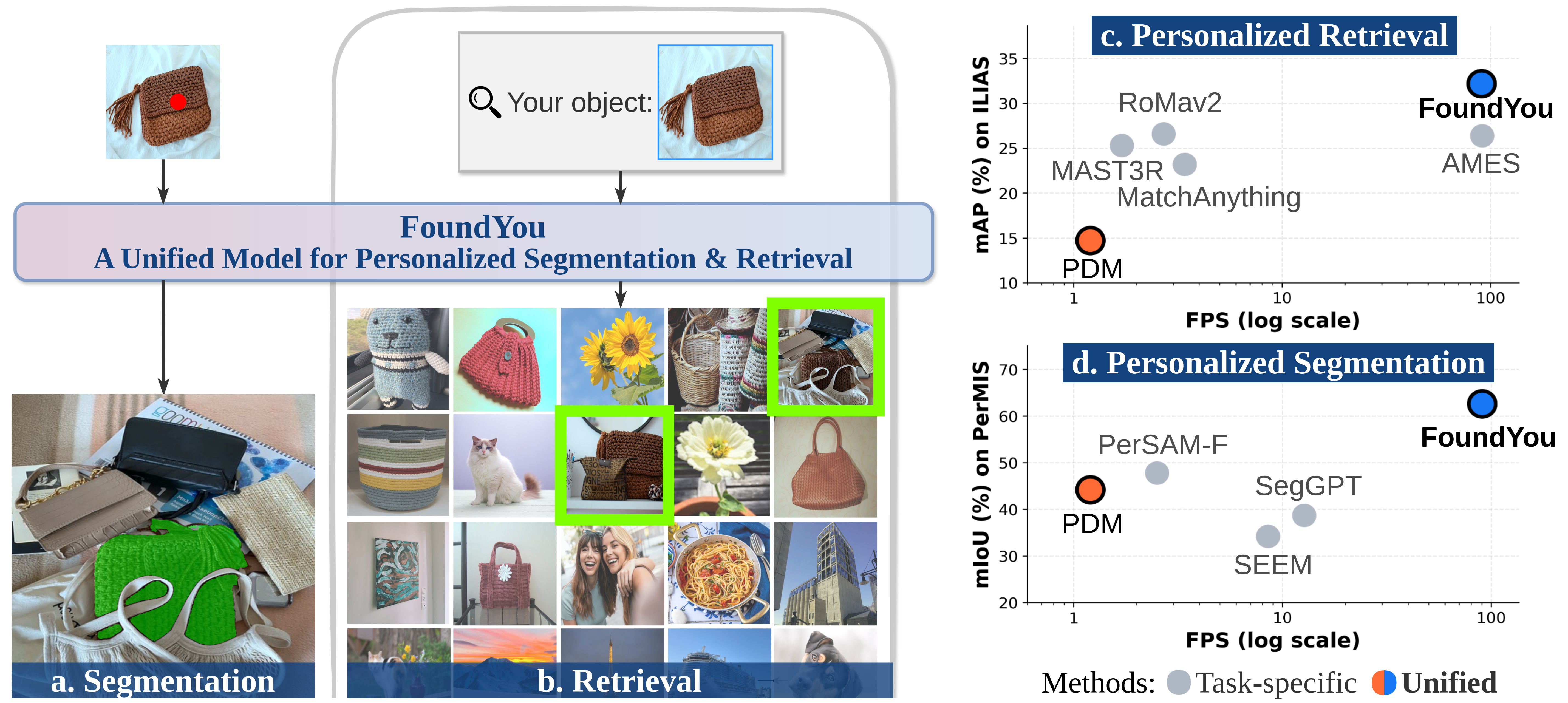
Give FoundYou one example of your object: segment it in new images or retrieve it from a large database with a single efficient model. FoundYou keeps SAM 2-small frozen and uses its memory attention to match an object across independent images instead of across video frames. It adds lightweight adapters to the image encoder and a retrieval decoder that turns the match into an image-level score, while the frozen SAM 2 mask decoder produces the masks.
model.safetensors: the 5.9 M trained parameters, i.e. the AdaptFormer adapters in the last two stages of the SAM 2 image encoder and the trained parts of the retrieval decoder (its transformer and object-score head). They were trained on UnED (Ypsilantis et al., ICCV 2023), with SAM 2 frozen.config.json: the model settings (the same values as configs/*.yaml in the code).The frozen SAM 2-small weights are not in this repository: the code downloads them to pretrain/ the first time the model is built (the same sam2_hiera_small.pt file as in facebook/sam2-hiera-small).
git clone https://github.com/ga1i13o/FoundYou && cd FoundYou
conda create --name foundyou python=3.10 -y && conda activate foundyou
pip install -r requirements.txt huggingface_hub safetensors
Save the example below as example.py in the repository root and run python example.py there (or paste it into Python started in the repository root). It uses the images in assets/: a reference photo of a toy with a box around it, 10 other photos of the same toy, and the paper's teaser figure, which does not show the toy.
import os

import torch
from huggingface_hub import snapshot_download
from PIL import Image
from safetensors.torch import load_file
from torchvision import transforms

from datasets.transform_utils import load_box
from models.foundyou import build_foundyou
from util.promptable_utils import build_prompt_dict

device = "cuda" if torch.cuda.is_available() else "cpu"
weights = load_file(os.path.join(snapshot_download("gabTriv/FoundYou"), "model.safetensors"))


def load_model(config_path):
    model = build_foundyou(config_path)  # the first call downloads SAM 2-small to pretrain/
    model.load_state_dict(weights, strict=False)  # the file has only the trained parameters
    return model.to(device).eval()


# Same weights, with the settings that the evaluation scripts use for each task
retrieval_model = load_model("configs/retrieval.yaml")
segmentation_model = load_model("configs/pers_seg.yaml")

# Same preprocessing as the evaluation scripts (the model resizes to 1024x1024 internally)
transform = transforms.Compose([
    transforms.Resize((518, 518)),
    transforms.ToTensor(),
    transforms.Normalize([0.485, 0.456, 0.406], [0.229, 0.224, 0.225]),
])


def load_image(path):
    return transform(Image.open(path).convert("RGB")).to(device)


# Reference: a photo of the object and a box around it, as [x1, y1, x2, y2] in the 518x518 frame
folder = "assets/spry_toodlesnap_863"
width, height = Image.open(f"{folder}/query/Q863_00.jpg").size
box_file = f"{folder}/query/Q863_00_bbox.txt"  # "x y w h" in pixels
box = load_box(box_file, original_size=(height, width), transformed_size=(518, 518))
reference = load_image(f"{folder}/query/Q863_00.jpg")
prompt = build_prompt_dict(box, "box", device)
photos = [f"{folder}/positives/P863_{i:02d}.jpg" for i in range(10)]
not_the_toy = "assets/FoundYou_teaser.png"  # the paper's teaser figure, without the toy

with torch.no_grad():
    # Personalized retrieval: the probability that each photo shows the reference object
    context = retrieval_model.encode_references([reference], [prompt])
    for path in photos + [not_the_toy]:
        logit = retrieval_model.score_candidates(load_image(path)[None], context)  # batch of 1
        print(f"{path}: {logit.sigmoid().item():.2f}")
    # Personalized segmentation: the mask of the object in a new photo
    context = segmentation_model.encode_references([reference], [prompt])
    logits = segmentation_model.segment_candidates(load_image(photos[0])[None], context)
    mask = logits.sigmoid() > 0.5  # [1, 518, 518]
    print(f"The mask covers {mask.float().mean().item():.0%} of {photos[0]}")
It prints a score between 0 and 1 for each image (higher means more likely to show the reference object): from 0.5 to 1.0 for the 10 photos of the toy, and about 0.05 for the teaser figure, which does not show it. Then it prints the share of the first photo covered by the predicted mask.
box = torch.tensor([x1, y1, x2, y2]) in the same frame (x times 518 / width, y times 518 / height) and pass it to build_prompt_dict(box, "box", device).encode_references, with one prompt each.{"prompt_type": "point", "prompt": {"point_coords": torch.tensor([[[x, y]]], dtype=torch.float32, device=device), "point_labels": torch.tensor([[1]], dtype=torch.int32, device=device)}} instead of prompt, with (x, y) in the 518x518 frame. For mask prompts, see inference_pers_seg.py.Results from the paper (segmentation with mask prompts; ILIAS: re-ranking the top 1,000 images retrieved by SigLIP, which alone reaches 19.6 mAP). FoundYou runs at 90.2 images/s on an RTX 4090.
| Task | Benchmark | Metric | FoundYou |
|---|---|---|---|
| Personalized segmentation | PerSeg | mIoU / bIoU | 96.4 / 85.6 |
| Personalized segmentation | PerMIS | mIoU / bIoU | 62.6 / 57.4 |
| Personalized retrieval | PerMIR | mAP | 92.1 |
| Personalized retrieval | ILIAS | mAP@1k | 32.5 |
@inproceedings{trivigno2026foundyou,
  title     = {{FoundYou}: A Unified Model for Personalized Segmentation and Retrieval},
  author    = {Gabriele Trivigno and Marcos Alfaro and Claudia Cuttano and Gabriele Berton and Luis Pay{\'a} and Carlo Masone},
  booktitle = {Computer Vision -- ECCV 2026},
  pages     = {585--604},
  year      = {2026},
  publisher = {Springer Nature Switzerland},
  address   = {Cham},
  doi       = {10.1007/978-3-032-37041-9_31}
}
Apache-2.0, like the code. The SAM 2 weights that FoundYou builds on are also released under Apache-2.0 (SAM 2 license).
Base model
facebook/sam2-hiera-small